

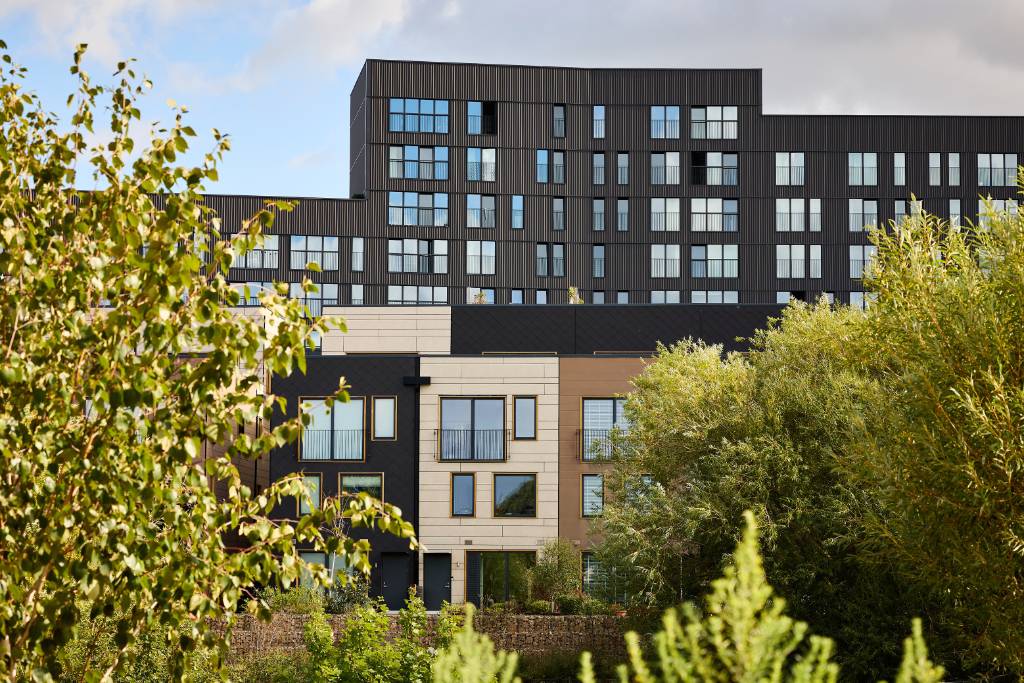
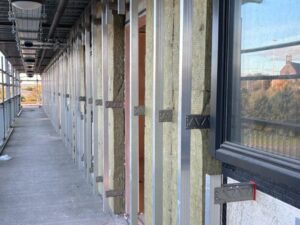
To maximise the thermal insulating capacity of a rear ventilated façade system, the design and specification of the metal substructure used to form it requires careful consideration. Also referred to as support framing, substructures are formed of metal brackets, rails and fasteners attached to the building substrate, providing the frame onto which the outer cladding materials or fascia can be fixed.
However, every bracket holding the frame and outer cladding to the structure breaks the layer of insulation, creating a thermal bridge. This effect can be so significant that it undermines the façade’s overall thermal performance.
Innovative EJOT CROSSFIX reduces thermal bridging
The thermal bridging potential in rainscreen façades can be significantly reduced by specifying the EJOT CROSSFIX substructure system. Manufactured in premium stainless steel, the system provides all the fasteners, anchors, rails and brackets needed to construct highly thermally efficient facades, as evidenced in its European Technical Assessment (ETA) and Passivhaus certification.
CROSSFIX maximises the façade’s insulating performance by reducing heat transfer through the substructure assembly. Key to this is its stainless steel composition, meaning it conducts far less heat than aluminium which is commonly used in façade substructures. Coupled with a thermal stop integrated into CROSSFIX Konsole brackets, stainless steel’s greater strength offers the potential for further thermal efficiency gains versus aluminium through a reduction in the number of brackets required overall.
Unlocking stainless steel’s potential
Stainless steel can offer significant thermal and structural advantages as the EJOT CROSSFIX system demonstrates. This metal’s thermal conductivity illustrates its superior performance. Aluminium brackets used in façade substructures typically have a thermal conductivity of between 160 and 220 W/mK, but in stainless steel brackets this ranges between 15 and 20 W/mK – making stainless steel between ten and fifteen times less conductive than aluminium.
Thermal gains through improved structural performance
An additional benefit results from stainless steel’s increased rigidity versus aluminium. Its higher load capacity and stiffness means, in certain projects, using stainless steel brackets rather than aluminium may allow bracket centres to be wider, subject to a full structural calculation.
With a reduction in the number of brackets per square metre, fewer structural connections link between the wall and the outer cladding – lowering the opportunity for thermal bridging in the first place. In addition, the cumulative effect of reducing thermal bridging using CROSSFIX can be so significant that the insulation thickness can be reduced, while still achieving the target U-value.
CROSSFIX is an excellent example of how system innovation can help developers work towards net zero. It also highlights the need to ensure thermal bridging is reduced within the substructure as a fundamental design principle. By addressing heat loss at every bracket and connection point, designers can create façades that not only meet today’s performance standards, but are better prepared for the demands of the future.